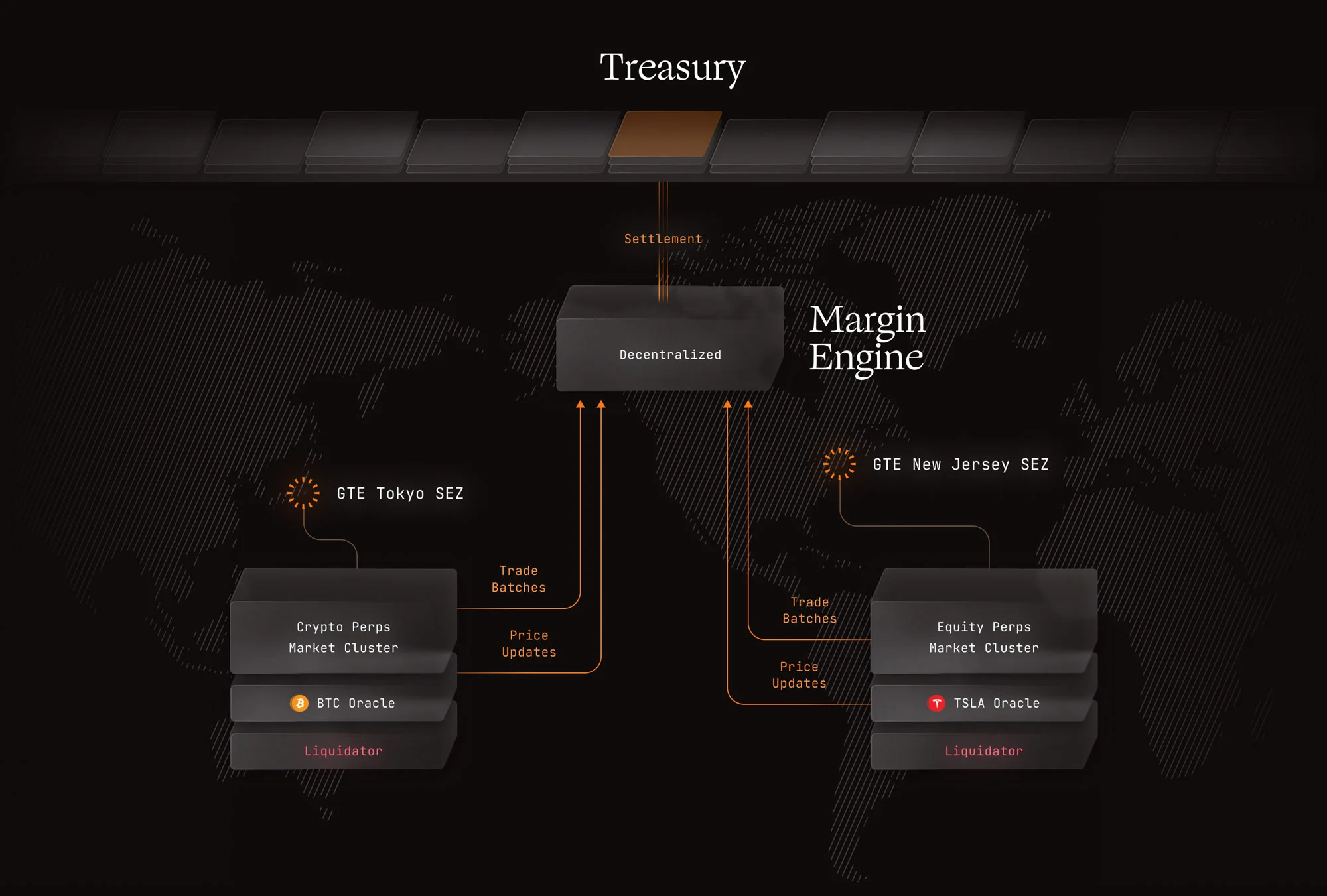
GTE Turbo operates across multiple SEZs, each running independent margin engines optimized for latency. This multi-region design recognizes that global financial markets operate across time zones and that latency-sensitive participants require infrastructure proximity.Each Special Economic Zone runs its own margin engine with local validators, optimizing for regional latency to achieve sub-millisecond execution for colocated participants. Zones maintain independent order books per market and submit trade batches to the global Margin Engine for final settlement. This architecture allows GTE to offer institutional-grade latency in each region while maintaining a unified global state.The Margin Engine remains globally unified, a single source of truth for all account state, reconciling trades from all regions. This separation allows execution to be regionally optimized while risk and settlement remain globally consistent.
Price discovery happens at a physical location: New Jersey for US equities, Tokyo for crypto, Chicago for commodities. Every microsecond of distance from those racks is a microsecond of uncertainty, and uncertainty has a cost. This is why HFTs pay for colocation - the closer you are to price discovery, the more accurately you can price risk, and the tigher you can quote.GTE is the first DEX to leverage the same principle: by placing SEZs in the data centers where spot price discovery actually happens, market makers quoting on GTE can hedge against the real-time spot feed with minimal latency. Tighter hedging means tighter spreads, which means better prices for every participant. A market maker in Tokyo quoting crypto perpetuals needs to hedge against centralized exchange prices originating from infrastructure in Asia. A market maker in New Jersey quoting US equity derivatives needs to hedge against NYSE feeds originating from NJ.If the matching engine is thousands of miles from the hedge venue, the market maker widens their spread to account for the latency risk, and the end user pays for it. SEZ enable us to retain decentralization while still giving our users the best possible prices.